skip to main |
skip to sidebar
9:21 AM
Unknown
The Pudu: World’s smallest deer. They live in bamboo thickets to hide from predators, and can weigh up to 12 kilograms (26 pounds).
9:17 AM
Unknown
Its Phyllomedusa sauvagii, commonly known as the Waxy Monkey Leaf Frog.They belonging to the subfamily of South and Central American leaf frogs that inhabits the Chaco (dry prairie) of Argentina, Brazil, Bolivia and Paraguay.
Males and females range from about 2 to 3 inches in length, with the females usually about 25% larger than males. They move by walking rather than hopping, which is the reason for the “monkey” in their name.
9:10 AM
Unknown
In this incredible macro photograph of a human eye, we see the stitches that resulted from a recent corneal transplant. The surgery was used to treat a patient suffering from Keratocnus, a degenerative disorder of the eye in which structural changes within the cornea cause it to thin and change to a more conical shape than its normal gradual curve.
3:23 PM
Unknown
Gate Tower Building With a Highway Through it
One of the most curious building in Japan is the Gate Tower Building in Osaka, Japan. The 5th, 6th and 7th floors of this 16-story office building is occupied by an express highway - passing right through the building. On the building's floor information board on the ground floor, the tenants for the three floors are listed as the Hanshin Expressway. You can’t alight there tough as the elevator skips from the 4th floor to straight to the 8th
3:11 PM
Unknown
The blobfish (Psychrolutes marcidus) is a deep sea fish of the family Psychrolutidae. Inhabiting the deep waters off the coasts of mainland Australia and Tasmania, it is rarely seen by humans.
Blobfish live at depths between 600–1,200 m (2,000–3,900 ft) where the pressure is several dozen times higher than at sea level, which would likely make gas bladders inefficient for maintaining buoyancy.Instead, the flesh of the blobfish is primarily a gelatinous mass with a density slightly less than water; this allows the fish to float above the sea floor without expending energy on swimming. Its relative lack of muscle is not a disadvantage as it primarily swallows edible matter that floats in front of it. Blobfish eat invertebrates like crabs and sea pens.
Blobfish can be caught by bottom trawling with nets as bycatch. Such trawling in the waters off Australia may threaten the blobfish in what may be its only habitat.
The blobfish is currently facing extinction due to deep-sea fishing or bottom trawling.
2:59 PM
Unknown
Whale learns to blow halo shaped bubbleA Beluga whale has become a sensation at an aquarium after learning how to blow halo-shaped bubbles. The extraordinary sight was captured on camera by photographer Hiroya Minakuchi at the Shimane aquarium in Japan. He said:"This beluga started making bubble rings when she was seven. And a couple of years ago she developed her technique. Now she blows the water from her mouth to make a current, which is not visible for us underwater. She then blows air from her blow hole into the current and that makes a ring shape."
2:56 PM
Unknown
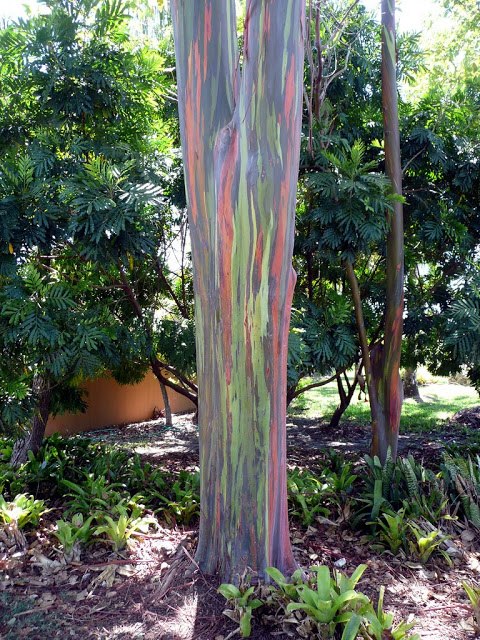
Eucalyptus deglupta is a tall tree, commonly known as the Rainbow Eucalyptus, the Mindanao Gum, or the Rainbow Gum. It is the only Eucalyptus species found naturally in the Northern Hemisphere. Its natural distribution spans New Britain, New Guinea, Ceram, Sulawesi and Mindanao.
In the pulpwood plantations of the Philippines it is the most common tree used for the production of pulpwood. It is a huge evergreen and can grow up to seventy five meters tall. The unique multi-hued bark is the most distinctive feature of the tree. Patches of outer bark are shed annually at different times, showing a bright green inner bark. This then darkens and matures to give blue, purple, orange and then maroon tones.




 Posts


